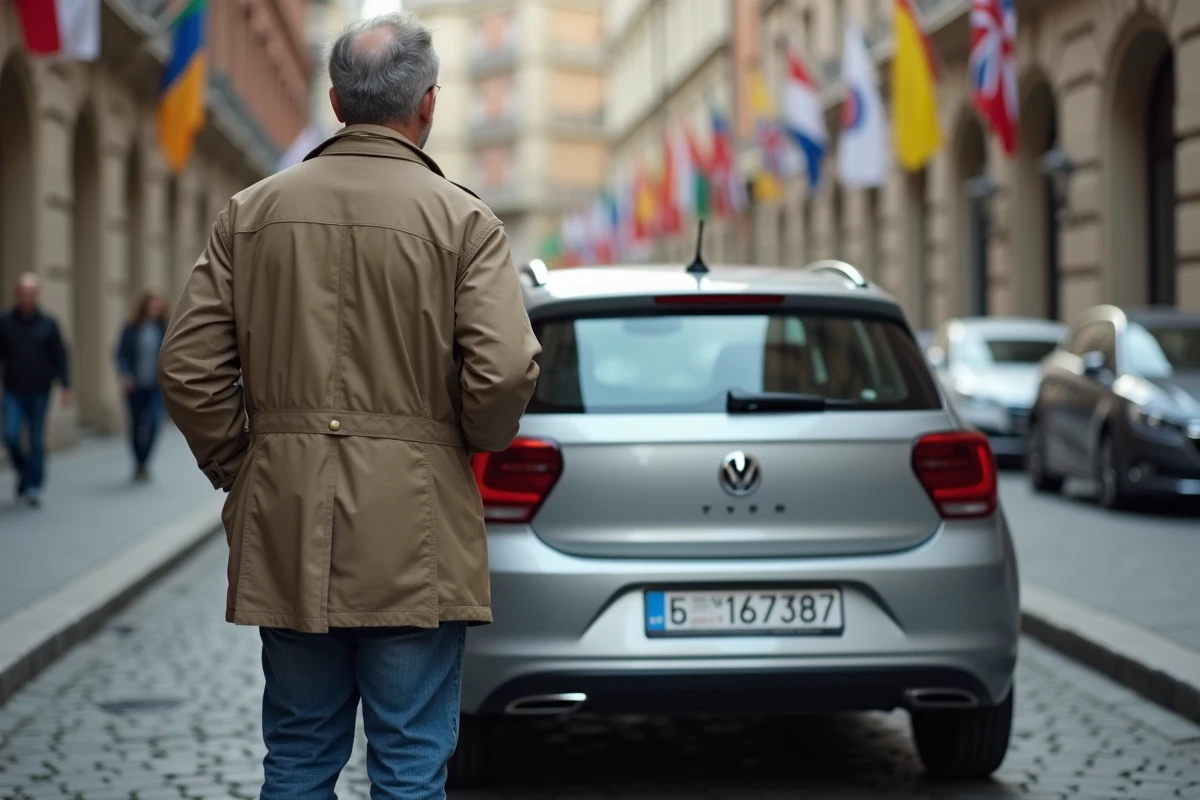
The code “GB” has disappeared from British plates in favor of “UK” since 2021, a direct consequence of Brexit and new international regulations. In Greece, the letter “GR” replaces the old “EL,” while Cyprus persists with “CY” despite European discussions on harmonization.
Some countries apply unprecedented alphanumeric formats, such as Switzerland, which incorporates cantonal coats of arms, or France, which maintains a distinction between DOM-TOM and the mainland. The variety of codes and formats reflects political, historical, and administrative choices unique to each state.
What are country codes on European license plates for?
On European highways, traffic sometimes erases borders, but the question of vehicle origin is more relevant than ever. The plates proudly display their country code: not just a simple detail, but a key for traceability, security, and traffic management. Behind each acronym lies an operational control system for law enforcement, customs officials, and highway companies. With a glance, any road check can determine the origin of a vehicle, whether it belongs to a lost motorist or is part of a targeted investigation.
The desire to standardize at the European level has favored homogeneous codes: F for France, D for Germany, I for Italy, derived from international conventions, but each state adjusts the application according to its priorities. The country code inscribed on the plate facilitates the exchange of information between administrations and strengthens cooperation, especially during offenses or investigations into thefts. It is no longer just an identifier: it is the pivot of seamless cross-border traffic.
License plates in Europe are a perfect illustration of this. Behind their apparent uniformity lie multiple nuances. For those who want to understand the workings, exceptions, and subtleties, the comprehensive overview provided by “License Plates in Europe” sheds light on these codes, formats, and their stakes.
Tour of Europe: complete list of acronyms and peculiarities by country
The European license plate is not overly standardized. It tells, in its own way, the administrative history and the refusal to erase the identity of each country. On the roads, each nation claims a distinct country code, immediately recognizable, which is no coincidence.
Main acronyms and specifics
Here are the most telling examples of this diversity:
- France: F, on a blue background adorned with the European flag. The format mixes two letters, three digits, and two letters.
- Germany: D for “Deutschland”. Here, the city of origin appears, followed by numbers, letters, and then the federal seal.
- Belgium: B, a red acronym on a white background. The numbers often start with one or two letters.
- Luxembourg: L, bright yellow background, black numbers in two groups separated by a dash (example: 12-3456). The Luxembourg license plate stands out instantly among others.
- United Kingdom: UK, replacing the pre-Brexit GB. The plate mixes letters, numbers, and displays the registration region. Since leaving the EU, the European band is no longer systematic.
- Bosnia and Herzegovina: BIH, blue band on the left bearing the country code.
Other countries like Italy (I), Spain (E), or Sweden (S) choose their own system, alternating numbers, letters, and sometimes regional coats of arms. On each car license plate, one can read the desire to maintain clarity of European reading while asserting national particularities. The country license plate is never neutral: it reflects sovereignty, memory, and resistance to total uniformity.

Formats, colors, euroband… What distinguishes plates from one country to another
Europe has never imposed a unique model for car license plates. While the European format has become widespread, with a white background, black characters, and a blue euroband on the left, each country stamps its mark. France offers a clear and sober layout: two letters, three digits, two letters. Germany places, at the top, the indication of the city, followed by the alphanumeric sequence.
In Luxembourg, the Luxembourg license plate is noticeable for its yellow background and double series of black numbers. Across the Channel, the color code differs by position: white at the front, yellow at the back, ensuring immediate identification of the vehicle’s direction.
The euroband, introduced in 1998, displays on a blue background the circle of golden stars and the country code. It facilitates identification during trips abroad, especially at borders and tolls. Some states outside the European Union adopt the principle but add their flag or a specific symbol.
This mosaic is not folklore: each format, each color, each position of the code carries a story, a belonging, a claim. The license plates in Europe are much more than an administrative formality. They reflect the ongoing tension between standardization and national assertion. On the road, they tell a European story that continues to be rewritten over the miles.