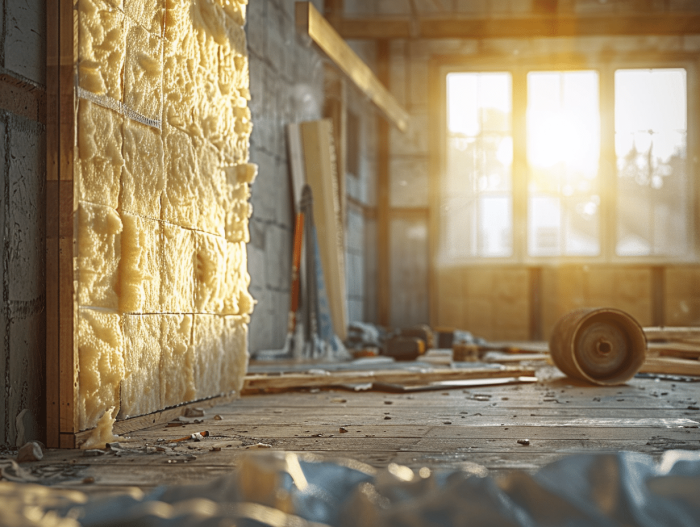
Concrete block walls, although popular for their strength and cost-effectiveness, can pose challenges in terms of thermal insulation. To improve the comfort of your home and reduce energy expenses, it is essential to properly insulate these structures.
Adding a layer of insulation to the internal or external surface of the wall can significantly enhance thermal performance. Consider materials such as fiberglass, expanded polystyrene, or cork panels. Each offers specific advantages in terms of thermal resistance and ease of installation.
Don’t forget to address thermal bridges, those areas where heat escapes more easily. Using insulating strips and properly sealing openings will ensure optimal and durable insulation.
Why and when to insulate a concrete block wall?
Concrete block walls are widely used in construction for their robustness and affordability. They have a low thermal resistance with an R-value of only 0.23 m²K/W. This characteristic makes them vulnerable to heat loss, making it essential to optimize their insulation.
Moisture and insulation
A concrete block wall has low moisture resistance. Without proper insulation, moisture can penetrate and deteriorate the structure, also affecting the comfort of the home. Installing a damp-proof course is recommended to prevent rising damp. This solution creates an effective barrier against moisture.
Current standards
During renovation or construction, it is imperative to comply with current standards for thermal insulation. These regulations aim to ensure optimal energy performance and reduce greenhouse gas emissions. A concrete block wall insulated according to these standards will significantly contribute to the overall energy efficiency of the house.
Renovation and construction
Whether during the construction of a new house or a renovation, insulating concrete block walls should not be overlooked. For renovation projects, insulate the walls to improve thermal and acoustic comfort while reducing energy bills. In new construction, prioritize effective insulation solutions from the start to avoid costly and labor-intensive future work.
The best techniques to optimize the insulation of your concrete block wall
Insulating concrete block walls can be done using various techniques, each with its advantages and disadvantages. Here are the main methods:
Insulation from the inside
- Thermoacoustic lining: Uses materials like polystyrene or fiberglass to improve thermal and acoustic comfort. This method results in a loss of living space.
- Stud wall: Allows the use of various insulators such as rock wool, wood fiber, or hemp. This technique requires the creation of a metal framework to compensate for the imperfections of uneven walls.
Insulation from the outside (ITE)
External insulation is the most effective solution for eliminating thermal bridges. It involves wrapping the house in an insulating layer, thereby reducing energy losses. This method requires the installation of a 2 cm air gap between the wall and the insulation to prevent moisture.
Choice of materials
The choice of insulation materials is fundamental:
- Polystyrene: Offers good thermal and acoustic results.
- Fiberglass: Has a lambda of 30, making it very effective for thermal insulation.
- Rock wool: Costs between 5 to 15 € per m², thus offering good value for money.
- Wood fiber: Must be kept away from any contact with water to avoid deterioration.
- Hemp: Costs between 10 and 25 € per m², ideal for eco-friendly constructions.
Adapt the technique to your particular situation, whether for new construction or renovation. The materials and methods chosen should meet the specific requirements of your project, ensuring optimal insulation.