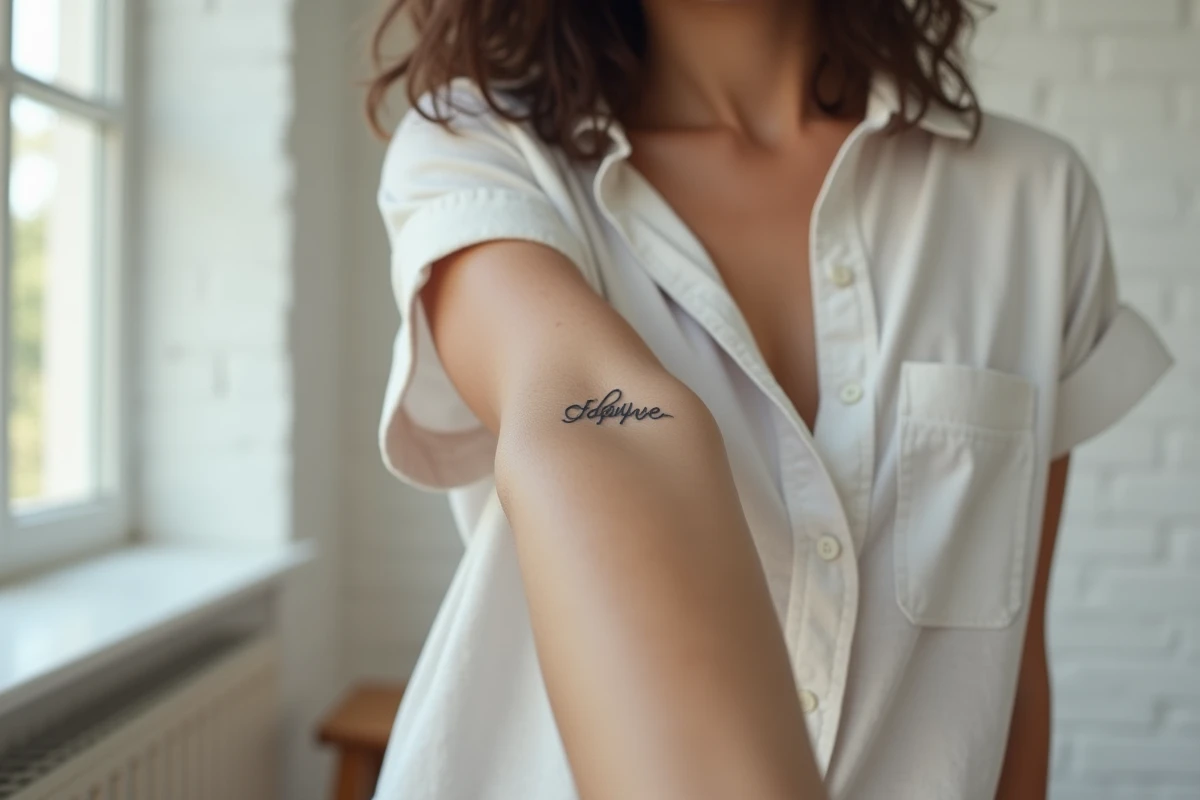
A name tattooed on the forearm is a word that lives with the body. It bends with the movement of the wrist, captures light depending on the angle, and changes appearance over time. The name tattoo on the forearm remains one of the most requested projects in studios, but the diversity of artistic approaches far exceeds the simple line of cursive text.
Ambigram Typography: A Name Readable Both Ways
Have you ever noticed that a name tattooed on the forearm is naturally read right-side up by the person wearing it, but upside down for those looking at it? This visual discrepancy leads some tattoo artists to work with ambigram typography, designed to remain readable in both orientations.
The principle relies on a symmetrical construction of the letters. Each character is drawn to function at 180 degrees. The result is not a simple mirror effect: it is a true typographic drawing job, letter by letter, that requires several sketch sessions before moving to ink.
This type of composition is particularly suitable for short names (four to six letters). Beyond that, readability deteriorates and the result can become confusing. A lettering specialist tattoo artist will be able to assess whether the chosen name lends itself to this exercise. To explore styles on Beauté Nature, the gallery provides a good overview of possible outcomes depending on the length of the name.
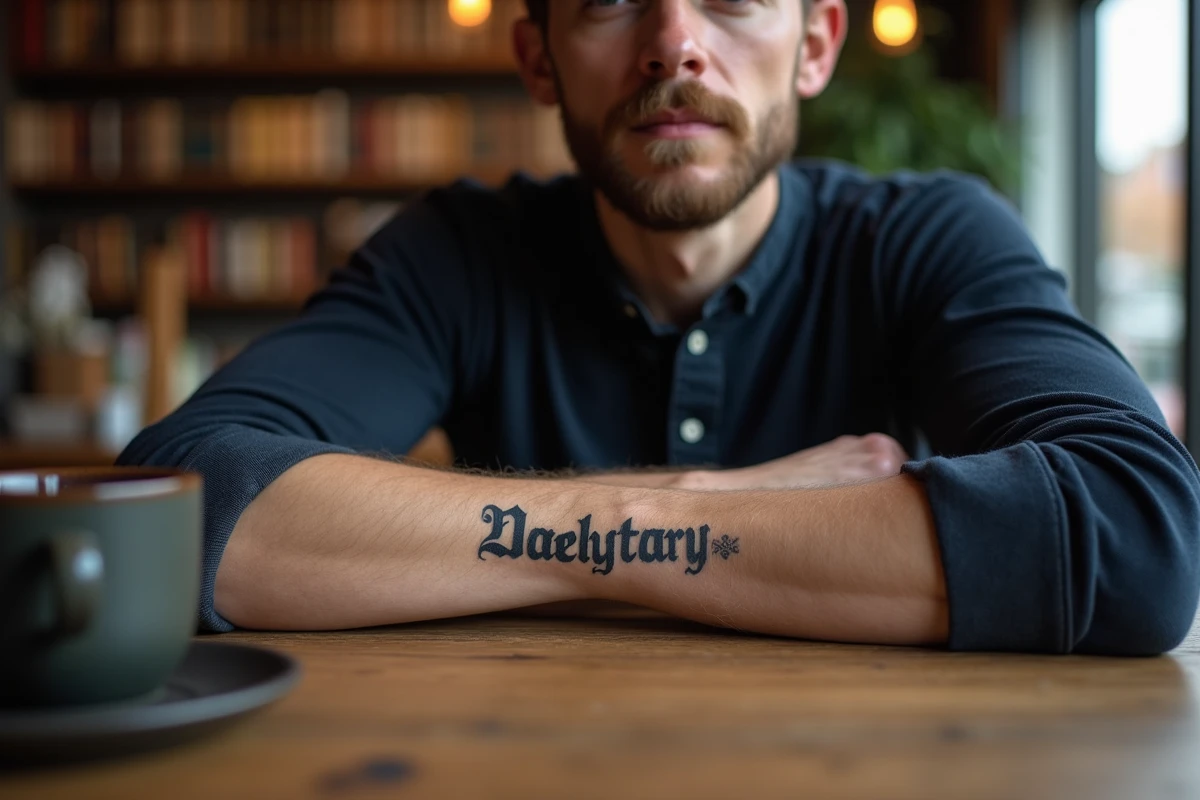
Name Tattoo in Patchwork Composition on the Forearm
The most striking trend in French studios over the past two years is the integration of the name into a composition known as “patchwork” or “sticker sleeve.” The name no longer floats alone on the skin. It takes its place among other small independent motifs, arranged like stickers on a sheet.
Specifically, a name in fine lettering can coexist with a flower, an astronomical symbol, a small portrait, or a date, without any element being connected to the others by a background or line. Each motif retains its graphic autonomy. The whole forms a personal mosaic that builds up over sessions.
The advantage of this approach: it allows for the addition of elements over time without redoing the overall composition. The name placed during the first session becomes an anchor point around which other tattoos will settle.
What Distinguishes a Good Patchwork from a Messy Result
- The spacing between motifs remains consistent, generally equivalent to two to three centimeters, to prevent the inks from blending as they age
- The graphic styles of the different elements share coherence (all in fine lines, or all in black and gray, for example)
- The tattoo artist anticipates the areas of the forearm that move the most (elbow bend, wrist rotation) to place the name in a stable area
Inks and Aging of a Name Tattoo on the Forearm
The choice of style directly influences longevity. Very fine lettering, done with a single needle, gives an elegant and discreet result at first. Over the years, fine lines widen and may lose sharpness, especially on the outer forearm, exposed to the sun.
Thicker lettering, such as bold or old school, ages better because the ink has more surface area to hold in the dermis. A name tattooed in thick script style remains readable much longer than ultra-fine lettering.
Regarding regulations, the ANSM updated its recommendations in 2024 for the application of the European REACH regulation on tattoo inks. Some pigments that were once common are now restricted or banned. A compliant studio uses inks certified according to this regulation. Don’t hesitate to ask about this during the initial consultation.

Initial Consultation and Cover-Up of Names: What Studios Have Changed
In recent years, serious studios have strengthened their protocols when a client requests a name tattoo. The reason is simple: requests for name cover-ups have significantly increased between 2021 and 2023, often after breakups or family changes.
Several studios now include a specific mention, either oral or written, during the consultation. The goal is not to discourage, but to ensure that the choice is well thought out. Some liability insurers even recommend this practice to tattoo artists.
Questions the Tattoo Artist Should Discuss with You
- Are the size and style of the lettering compatible with a potential future cover-up if you change your mind?
- Does the placement on the forearm allow for the integration of the name into a broader composition later on?
- Will the skin color and hairiness of the chosen area affect long-term readability?
A tattoo artist who takes the time to ask these questions shows that they think beyond the session of the day. A good name lettering is as much about preparation as it is about tattooing.
The name tattoo on the forearm doesn’t need to be complex to make an impact. A well-placed word, in a carefully chosen typography and executed by a tattoo artist who masters lettering, is enough to create something lasting. The choice of style, whether ambigram, patchwork, or classic, deserves as much attention as the name itself.